Project planning guide
Before you build
Use the reference image and planning notes as a starting point. Confirm dimensions, loads, materials, local codes, and site conditions before purchasing or cutting.
- Garage Projects
- 1 reference image
- Print-friendly guide
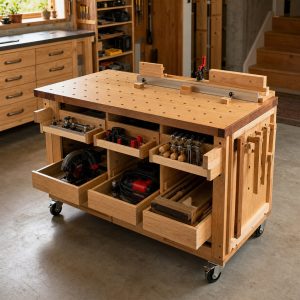
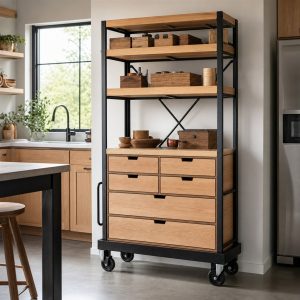
Quick answer: A useful rolling tool cart is about 24 inches wide, 20 inches deep, and 36 to 40 inches tall. A plywood carcass keeps it rigid, pegboard sides hold hand tools, shallow drawers organize small items, and four locking swivel casters let the cart work from either side.
Choose a stable footprint
Start with the narrowest doorway and the parking space beside your bench. The cart should pass through both with tools attached. Keep the center of gravity low: batteries, routers, and boxed tools belong on the bottom shelf, not in a tall top tray.
Build the carcass square
Use 3/4-inch plywood for the sides, bottom, and structural partitions. A full back or fixed central stretcher prevents racking, while pegboard can overlay framed side openings. Assemble on a flat surface and compare diagonals before installing drawer slides. Reinforce the caster mounting area with doubled plywood or solid blocking.
Divide storage by frequency
- Top tray: current-job tools and fasteners.
- Shallow drawers: bits, measuring tools, and consumables.
- Eye-level pegboard: pliers, drivers, and frequently used hand tools.
- Lower shelf: heavy cases and compact bins.
A removable tray is useful only if it has handholds and a positive seat. Keep tools below the rim so they do not fall when the cart rolls over a concrete joint.
Select and mount casters
Use four matching swivel casters with brakes appropriate to the cart and expected load. Through-bolts or substantial screws into reinforced material are preferable to short fasteners in a thin panel. Larger wheels cross garage control joints more easily. Lock all four wheels when the cart serves as a work surface.
Keep pegboard tools secure
Use locking clips or retainers so hooks do not pull out with the tool. Do not hang sharp tools at knee height or allow long items to project beyond the cart footprint. If most tools will stay on one wall, the garage pegboard system may be a better primary organizer; the cart should carry only what moves with the work.
Control the cart’s center of gravity
Pegboard invites tools to be stored high, but dense tools above a narrow wheelbase can make the cart unstable. Put batteries, power tools, and hardware low, then add lighter hand tools to the panel. Test turning, stopping, and crossing a floor joint with partial loads before filling every hook.
- Use positive retainers for tools that can swing while rolling.
- Keep sharp points facing inward or behind guards.
- Place push handles where hands do not contact hanging tools.
- Choose wheels for debris, floor condition, and total loaded weight.
Park the cart on a level area and engage all practical brakes before using its top as a work surface. If side pressure causes movement, revise the base or use the cart only for storage.
Common questions
Are two locking casters enough?
Four brakes provide better control on a mobile work cart, particularly if forces can come from several directions. Choose hardware based on the finished load and floor.
How tall should a rolling tool cart be?
Match the top to nearby benches if it will support workpieces. For storage only, keep it low enough to see into the tray and move without blocking your view.