Project planning guide
Before you build
Use the reference image and planning notes as a starting point. Confirm dimensions, loads, materials, local codes, and site conditions before purchasing or cutting.
- Garden Projects
- 1 reference image
- Print-friendly guide
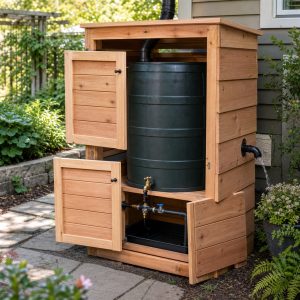
Quick answer: Install a closed rain barrel on a broad, level base that can support its full water weight. Use a screened inlet or compatible downspout diverter, a sealed lid, a usable spigot height, and an overflow route that carries water safely away from the foundation. Check state, municipal, HOA, and mosquito-control requirements before connecting it.
Understand the full weight
Water weighs roughly 8.34 pounds per U.S. gallon. The water in a full 55-gallon barrel alone is about 459 pounds, before the container and hardware. Do not place that concentrated load on loose stacked bricks, an unverified deck, or a narrow decorative stand. Use a compacted, level pad and a broad platform made for the load.
Choose a downspout and overflow destination
Select a downspout with safe access and a nearby planted area that can accept overflow. Preserve the original drainage path or provide a diverter that returns excess water to the downspout. Never discharge beside the foundation, into a window well, across a sidewalk, or onto neighboring property.
Set the base and barrel
- Call for utility location before digging or driving stakes.
- Remove soft organic material and compact a level aggregate pad.
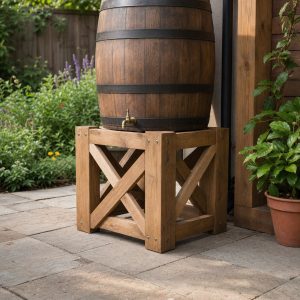
- Build a broad platform from rated blocks and a solid top, following barrel instructions.
- Set the empty barrel in place and confirm it cannot rock.
- Orient the spigot so a watering can fits without making the base unnecessarily tall.
- Secure the barrel against tipping if the manufacturer or site conditions call for it.
Connect a mosquito-safe inlet
Use a tightly screened inlet, sealed lid, and screened overflow so mosquitoes cannot enter. A downspout diverter reduces open penetrations when it is compatible with the barrel. Clean roof debris from gutters and do not connect roofing that may contaminate water for the intended plants. Rain-barrel water is generally treated as nonpotable unless a properly designed and regulated system says otherwise.
Route and size the overflow
A small roof area can fill a barrel quickly during a hard storm. The overflow should be at least as deliberate as the inlet: use secure fittings, a hose that will not kink, and a discharge area that resists erosion. Test the system with a hose before the first storm and observe it during actual rain from a safe location.
Use the water appropriately
Apply collected water to ornamental beds or soil around suitable garden plants, following local public-health and extension guidance. Avoid drinking, handwashing, and overhead application to edible leaves unless an authoritative local program specifically supports that use and the system is designed accordingly. Keep the outlet closed and inaccessible to small children.
A rain barrel can support the vertical garden planter or raised bed, but it does not replace consistent irrigation planning during dry weather.
Seasonal maintenance
- Clean the screen, gutters, and sediment periodically.
- Check the base after heavy rain and frost movement.
- Inspect hoses for leaks and mosquito openings.
- Disconnect, drain, and protect the barrel before freezing where required.
- Restore the downspout’s normal drainage path during winter storage.
Common questions
Are rain barrels legal everywhere in the United States?
Rules differ by state, locality, water district, and property agreement. Verify current local requirements before installation.
Why does a rain barrel need elevation?
Modest elevation creates room for a watering can and some gravity pressure. Stability is more important than height; never build a tall narrow stand for extra pressure.