Project planning guide
Before you build
Use the reference image and planning notes as a starting point. Confirm dimensions, loads, materials, local codes, and site conditions before purchasing or cutting.
- Garden Projects
- 1 reference image
- Print-friendly guide
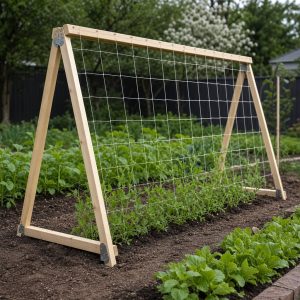
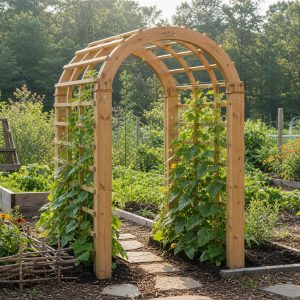
Quick answer: A freestanding A-frame trellis about 6 feet tall and 4 feet wide can support beans, peas, and many cucumbers while allowing harvesting from both sides. Use exterior-rated lumber, galvanized or durable garden mesh, strong top connections, and ground anchors. Match the structure to the mature weight and wind exposure of the crop rather than its size on planting day.
Match the trellis to the plant
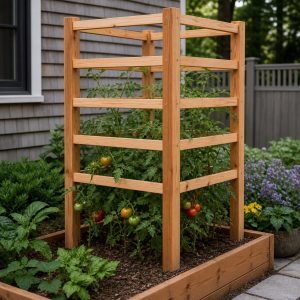
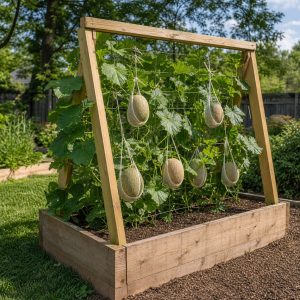
Peas and beans climb readily on narrow mesh or twine. Cucumbers need larger openings for harvesting and a frame that can support wet foliage and fruit. Heavy squash and melons require a stronger system and may need individual fruit slings. A decorative lattice built for a light annual vine should not be assumed suitable for a dense food crop.
Size the A-frame for access
A useful frame begins with two matching side triangles joined by a ridge. Keep the feet far enough apart to resist tipping but close enough that both faces remain reachable. A 6-foot ridge provides growing height without requiring a ladder for most harvesting. If children will garden, dedicate a lower section rather than reducing the stability of the entire structure.
| Decision | Planning point |
|---|---|
| Height | About 5 to 7 ft. for common annual vines |
| Width along ridge | About 4 ft. per modular section |
| Mesh opening | Large enough for hands and harvest |
| Placement | Where mature vines will not shade lower crops unnecessarily |
Build two identical ends
- Lay two legs on a flat surface and overlap or join them at the top.
- Set the foot spread with a lower crosspiece.
- Build the second end directly over the first so the angles match.
- Stand the ends, connect them with a straight ridge, and add lower longitudinal rails.
- Check the frame for rack before tightening every fastener.
- Attach mesh with smooth, corrosion-resistant staples or washers, folding cut edges away from hands.
Do not rely on a few light staples to carry the whole vine load. Wrap or clamp the mesh at structural rails and keep sharp wire ends inside folded hems.
Anchor for wind and wet plants
A leaf-covered trellis behaves like a sail, and rain adds weight. Use ground stakes, earth anchors, or secure attachment to a raised-bed frame designed to accept the load. Do not drive stakes until utilities are located. In exposed areas, diagonal bracing is more useful than simply increasing the number of screws at the ridge.
Place and plant intelligently
Orient the trellis so it does not cast unwanted shade across sun-loving crops. In many U.S. gardens that means placing tall supports toward the north side, but the surrounding buildings and seasonal sun path matter. Seed or transplant along both faces at the crop’s recommended spacing, then guide young vines loosely rather than tying stems tightly.
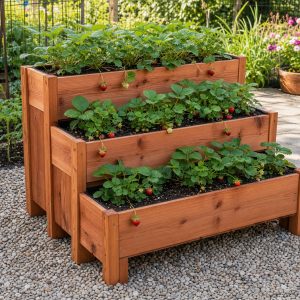
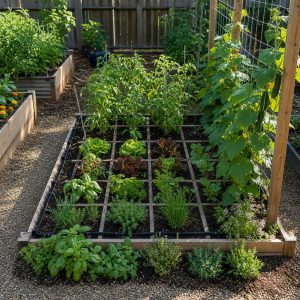
This trellis pairs with the 4×8 raised garden bed. For patios, the smaller vertical garden planter keeps herbs and shallow-rooted crops in a compact footprint.
End-of-season care
- Cut vines away instead of pulling hard against the mesh.
- Inspect anchors, ridge joints, and wire fasteners.
- Replace broken strands before they produce sharp edges.
- Clean plant debris that could harbor disease.
- Store a folding frame dry, or reseal exposed wood as needed.
Common questions
Can a trellis attach directly to a raised bed?
Yes, when posts extend to sound framing or ground support. Fastening only to a thin top board can lever that board outward once vines become heavy.
Is cattle panel suitable for a garden trellis?
It can be durable and harvest-friendly when cut edges are made safe and the panel is attached to appropriately anchored supports. Confirm the panel coating and opening size suit the project.