Project planning guide
Before you build
Use the reference image and planning notes as a starting point. Confirm dimensions, loads, materials, local codes, and site conditions before purchasing or cutting.
- Garage Projects
- 1 reference image
- Print-friendly guide
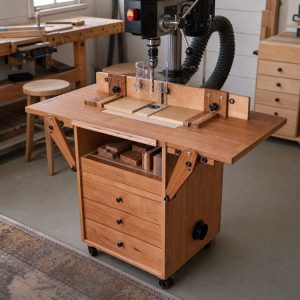
Quick answer: A small-shop miter saw station works best as a mobile center cabinet with an adjustable recessed deck and folding support wings. Size the deck to your actual saw, align the wings with its table, and plan the parked footprint before adding storage.
Measure the saw in every position
Record the base footprint, table height, rear slide travel, full miter swing, bevel movement, dust port, handle height, and the path for blade changes. A station that fits the saw at 90 degrees may block it at a 45-degree miter. Preserve the manufacturer’s required clearances and guarding.
Set the deck before building the wings
The station’s critical dimension is the difference between the saw base and its work table. Build the center deck adjustable with shims or slotted supports so the saw table can finish exactly flush with both wings. Verify with a straightedge across the complete width.
Use folding supports intelligently
Each wing needs a positive open stop and a brace that cannot collapse from vibration. A fence improves repeatability but should not interfere with the saw’s own fence, bevel controls, or moving head. Add a stop track only after confirming the fence is straight from end to end.
Design a stable rolling base
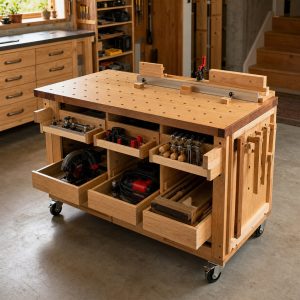
- Use four load-appropriate locking casters mounted to reinforced corners.
- Keep drawers shallow near the top and heavier accessories low.
- Make the base wide enough to resist tipping with one wing loaded.
- Lock every caster before cutting.
- Provide a dedicated parking position outside the vehicle path.
Control dust without blocking the saw
Connect the factory dust port and consider a broad collection hood that does not restrict slide or miter movement. Avoid tight hose bends. Vacuum the cabinet rather than allowing fine dust to accumulate around drawer slides and power connections. Wear eye and hearing protection and follow the saw manual; OSHA’s woodworking resources also emphasize guarding, dust capture, and noise control.
Build order
- Make a square center cabinet and reinforced caster base.
- Install the saw deck and level the machine table.
- Build wings, then fit braces and positive stops.
- Align the fence with a long straightedge.
- Add drawers only after moving parts and dust paths are proven.
- Test with scrap at short lengths before supporting long stock.
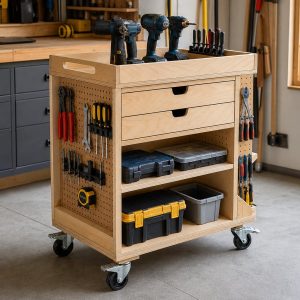
Pair the station with a rolling pegboard tool cart or review the existing stable sawhorse construction guide for portable support ideas.
Verify support during the full cutting cycle
A board can appear supported at setup but become unstable after the offcut separates. Test short trim, long boards, and repeated stop-block cuts with the saw unplugged. The workpiece must stay flat against the fence and supported on both relevant sides without forcing the operator to catch a falling piece.
- Keep folding wings positively locked in both raised and stored positions.
- Prevent wheels or leveling feet from contacting dust piles and offcuts.
- Leave motor vents, bevel controls, and dust ports accessible.
- Store the cord where rolling the station cannot damage it.
Follow the saw manufacturer’s clearance and mounting instructions. After moving the station, lock it, verify level with the wings, and check the fence alignment before making a cut.
Common questions
How high should a miter saw station be?
Set the wing surface to a comfortable working height, commonly near 34 to 38 inches, then recess the saw so its table—not its base—matches that height.
How long should the wings be?
Use the longest wings that can open safely in your shop and support common stock. Folding wings around 3 to 4 feet each are practical in many compact garages.