Project planning guide
Before you build
Use the reference image and planning notes as a starting point. Confirm dimensions, loads, materials, local codes, and site conditions before purchasing or cutting.
- Garden Projects
- 1 reference image
- Print-friendly guide
Quick answer: A two-wheel garden cart is easier to balance than a wheelbarrow when its axle sits near the loaded box’s center of gravity. Build a rigid exterior plywood body on a reinforced frame, use matched pneumatic wheels and a rated axle assembly, keep handles at a comfortable height, and never claim a load capacity that has not been engineered or tested.
Define the route and cargo
Measure the narrowest gate, path curves, slopes, and shed doorway. Decide whether the cart will carry loose mulch, bagged soil, tools, or plants. A wide box is stable on open lawn but awkward through a 36-inch gate. Large wheels cross roots and gravel more easily than small casters.
Plan the box and balance point
A useful starting box is roughly 36 inches long, 24 to 30 inches wide, and 12 inches deep. Sloped front or rear panels simplify dumping, while removable end panels help with long items. Position the axle so a typical load leaves manageable weight at the handles without tipping backward when parked.
Build a rigid weather-resistant body
- Cut exterior plywood floor, sides, and ends.
- Seal panel edges before inaccessible joints are assembled.
- Fasten the box to a 2x chassis with corrosion-resistant hardware.
- Add corner cleats and a top rim to resist panel spread.
- Install two aligned handle rails extending beyond the box.
- Add a front parking leg or stable resting frame.
Install wheels and axle carefully
Use a matched axle, hubs, bearings, washers, and retainers designed to work together. Keep the axle square to the cart centerline so it does not steer sideways. Reinforce mounting points and preserve wheel clearance with the box loaded. Cotter pins or specified retainers should be fully engaged.
Test with gradual loading
Start empty on level ground, checking tracking, handle height, and parking stability. Add small, evenly distributed loads and watch the frame, axle mounts, tire clearance, and handle weight. Keep dense bags low and centered. Do not carry riders or tow a hand cart behind powered equipment unless specifically designed for it.
Maintain the cart
- Check tire pressure and hub retention.
- Wash soil out and let the box dry.
- Repair damaged edge sealing.
- Tighten chassis and handle fasteners.
- Store under cover with the box empty.
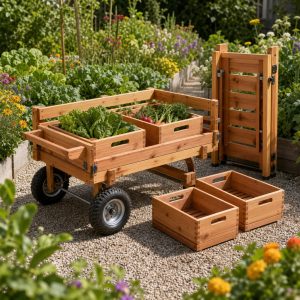
Roll the cart over the gravel garden path and into the shed using a properly sized shed ramp.
Tune balance with progressive load tests
The axle position should make the loaded handles manageable without allowing the cart to tip backward when parked. Begin with light, evenly distributed material and increase the load gradually on the real route. Test turns, slopes, soft soil, path edges, and stopping; a cart that feels balanced on a level shop floor may behave differently outdoors.
- Keep dense cargo low and prevent it from shifting toward one wheel.
- Provide stable parking legs that do not sink easily into soil.
- Shield users from axle ends, spoke hazards, and pinch points.
- Use wheel and axle components rated for the intended total load.
Inspect tire pressure, wheel retention, handle joints, and body fasteners before heavy use. Do not ride in a utility cart unless it was specifically designed and verified for carrying people.
Common questions
Are bicycle wheels suitable for a garden cart?
They can roll well, but hubs, axle compatibility, side loads, spokes, tire condition, and attachment all matter. Use a complete matched system rather than improvising critical retainers.
Should the axle be in the middle?
It should be near the loaded balance point, which may not equal the geometric center. Prototype the position before permanently drilling mounts.