Project planning guide
Before you build
Use the reference image and planning notes as a starting point. Confirm dimensions, loads, materials, local codes, and site conditions before purchasing or cutting.
- Garden Projects
- 1 reference image
- Print-friendly guide
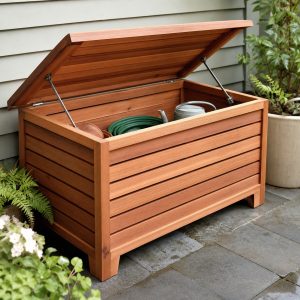
Quick answer: A useful outdoor storage bench is about 5 feet long, 18 to 20 inches deep, and roughly 18 inches high at the seat. Build a rigid exterior frame, support the seat span, use a lid stay that prevents slamming, ventilate the compartment, and design every surface to drain rather than promising waterproof storage.
Decide what belongs inside
Store clean plastic pots, kneeling pads, empty trays, and weather-tolerant supplies. Do not store fuels, pesticides, wet soil, battery chargers, or food in an ordinary wood bench. Outdoor cushions need far better rain protection and airflow than hand tools.
Test comfortable dimensions
| Feature | Starting point |
|---|---|
| Seat height | 17 to 19 in. |
| Seat depth | 18 to 20 in. |
| Length | About 60 in. for two or three adults |
| Back angle | Prototype for comfort before fixed joinery |
Do not let storage volume force an uncomfortable seat. Mock up the seat and back with scrap before cutting finished material.
Build the structural frame
- Assemble two matching leg frames from exterior-suitable lumber.
- Join them with front and rear rails.
- Add a center seat support for a five-foot span.
- Install a raised compartment floor with drainage gaps.
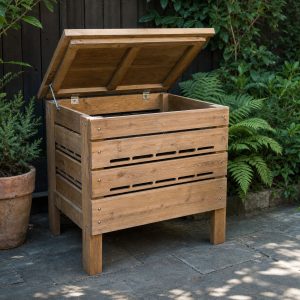
- Fit ventilated side and back panels.
- Add the backrest frame and check for racking.
- Secure the seat/lid with exterior hinges and two safe lid supports.
Manage water instead of trapping it
Slope or gap seat boards so water leaves. Keep the compartment floor above patio splash, add lower ventilation, and avoid an unvented plastic liner that captures condensation against wood. A breathable interior bin can organize small items while remaining removable for drying.
Make the lid safe
A large solid lid is heavy and can catch wind. Use suitable corrosion-resistant hinges, lid stays, and finger clearance. Divide an oversized lid into smaller sections if needed. Confirm the lid cannot fall closed when a user reaches inside.
Finish and placement
Round exposed edges, seal cut ends, and apply an exterior finish compatible with seating. Put feet on stable pavers or pads rather than damp soil. Anchor only where wind, public use, or local conditions require it, using a detail that does not trap water.
Place the bench beside the garden path. Keep active work supplies on the existing potting bench.
Separate seating loads from storage weatherproofing
The bench frame must safely carry people even when the storage compartment is empty. The lid and interior lining should not be treated as structural unless designed that way. Use drainage gaps, sloped surfaces, and ventilation to manage water; trying to seal an outdoor wood box completely can trap condensation inside.
- Use lid supports selected for the lid’s actual weight and opening angle.
- Keep finger-clearance details around all closing edges.
- Store only items that tolerate the compartment’s temperature and humidity.
- Raise wood and hardware away from standing water and soil.
Load-test the seat gradually and operate the lid repeatedly before use. Inspect hinges, supports, finish, drainage paths, and concealed corners each season, removing stored items if dampness or pests appear.
Common questions
Can an outdoor wood bench be waterproof?
Wood movement, joints, and ventilation make a truly waterproof compartment difficult. Design for rain shedding and drying, or use a removable sealed container inside.
Is plywood suitable outdoors?
Exterior-rated plywood can work when fully supported and its edges are protected, but slatted decay-resistant lumber is easier to drain and repair in exposed seating.